Smart Application
Smart Application is an enterprise-grade,
on-premises super-application that serves as a unified operational hub for facility-wide building management. It centralizes provisioning, Trend, and Lighting, Package air conditioning, and Sensors subsystems through a single, intuitive interface.
Client
NDA (Non-Disclosure Agreement) - Japan
Type
Enterprise IoT, Industrial B2B, Operational Technology (OT)
Industry
IOT, Building and energy management
Platform
Web, and Mobile application
Services
User Research
Design System
User Interface
Interaction Design
Smart Application
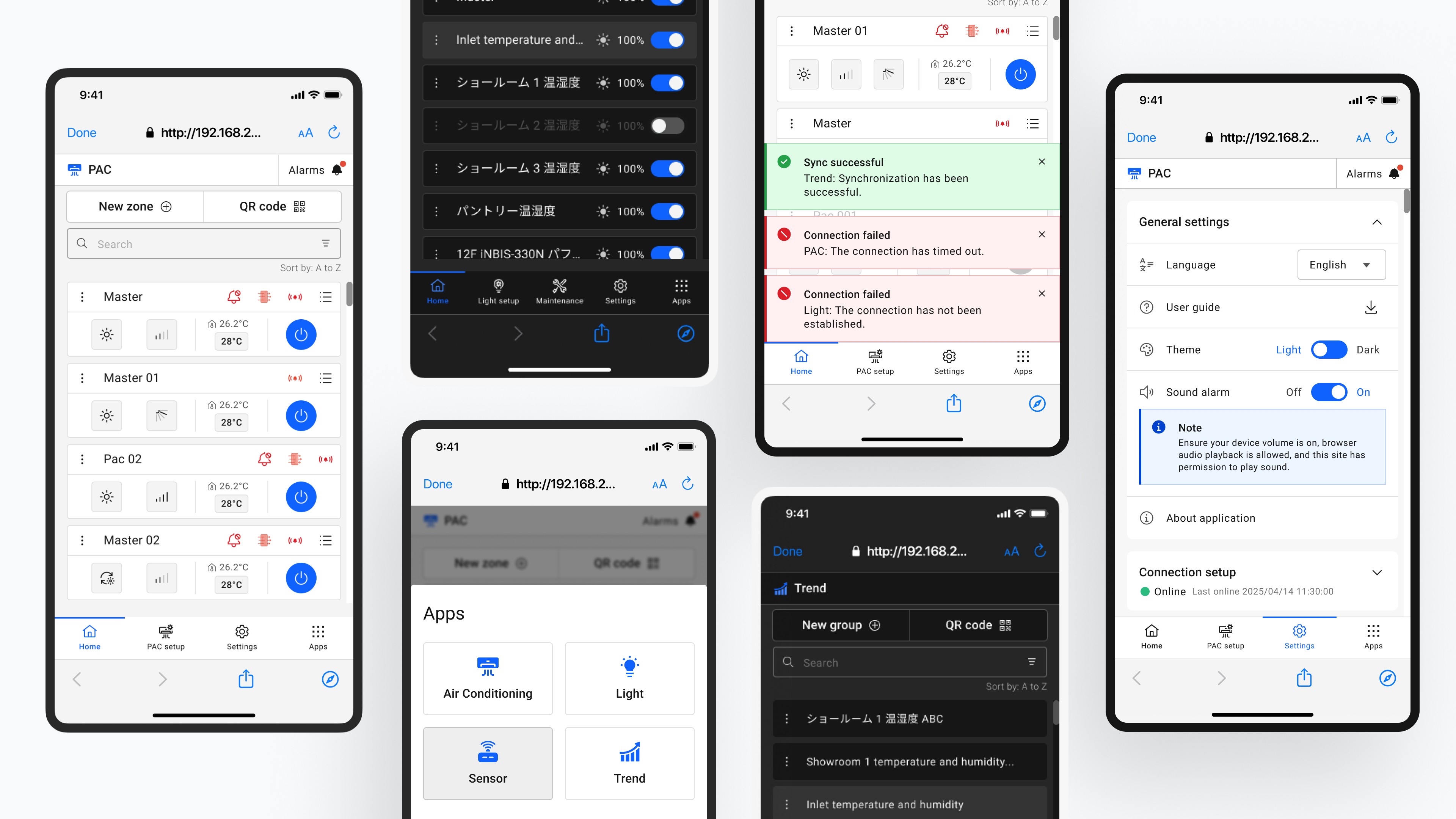
The architecture employs a modular micro-frontend approach accessible through a unified Application Navigator. This enables fluid switching between specialized core modules:
Light Application: Delivers On/Off control, precision dimming, and flexible virtual zone grouping for supported lighting controllers.
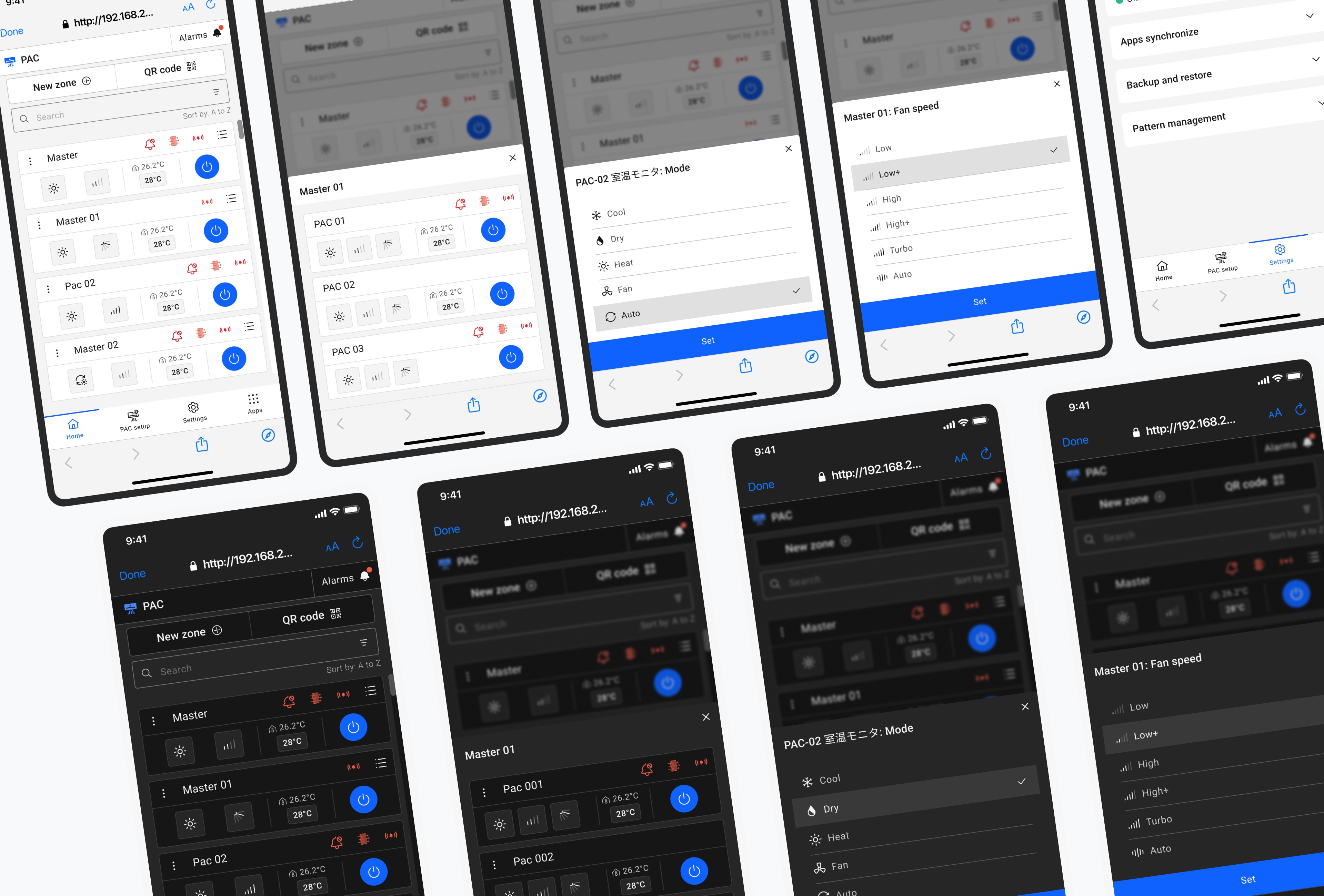
PAC Application: Provides comprehensive control over Package Air Conditioning units with multi-variable climate management.
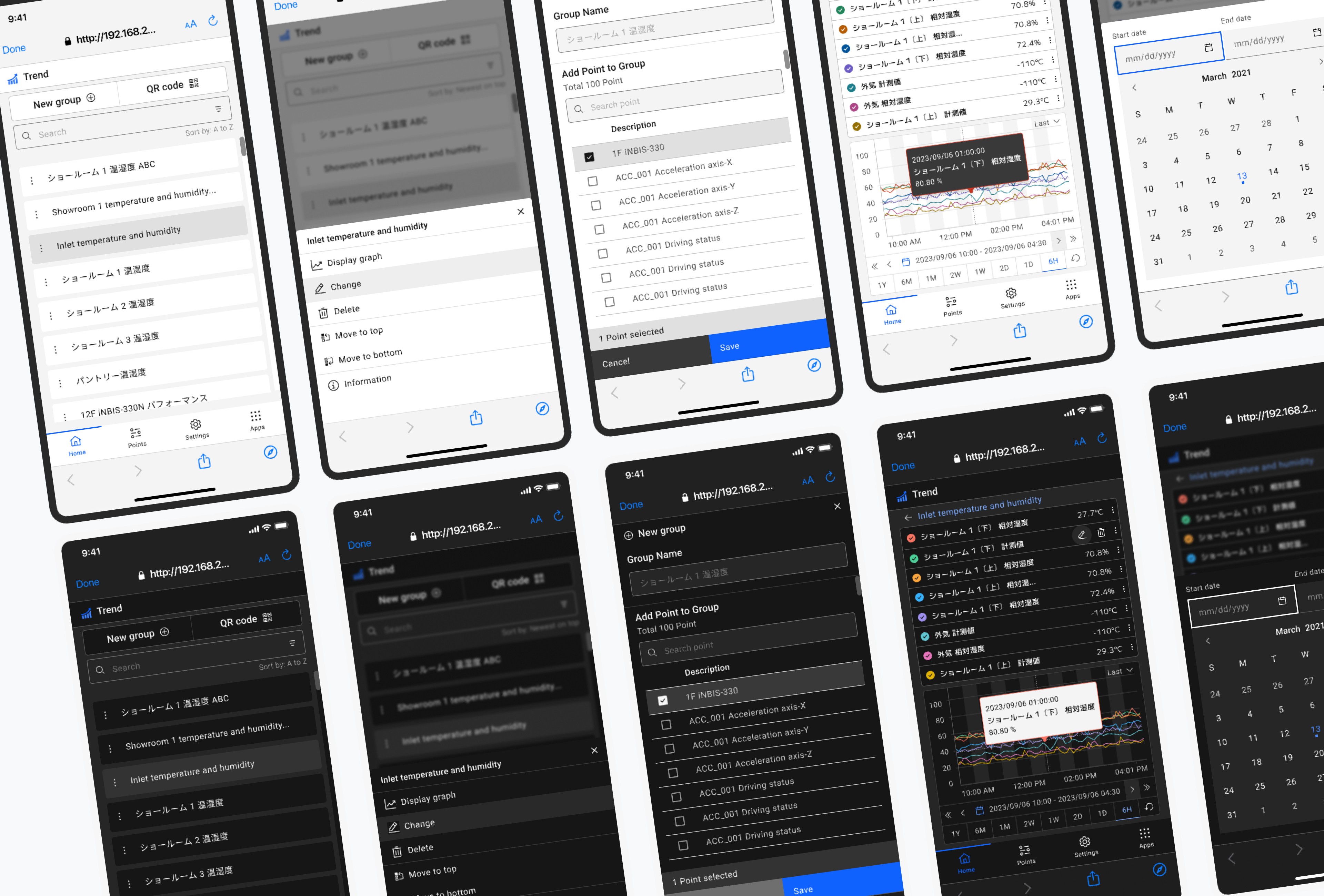
Trend Application: Offers powerful analytics through digital totalizers and time-series line charts for C02, energy, and energy types consumption tracking.
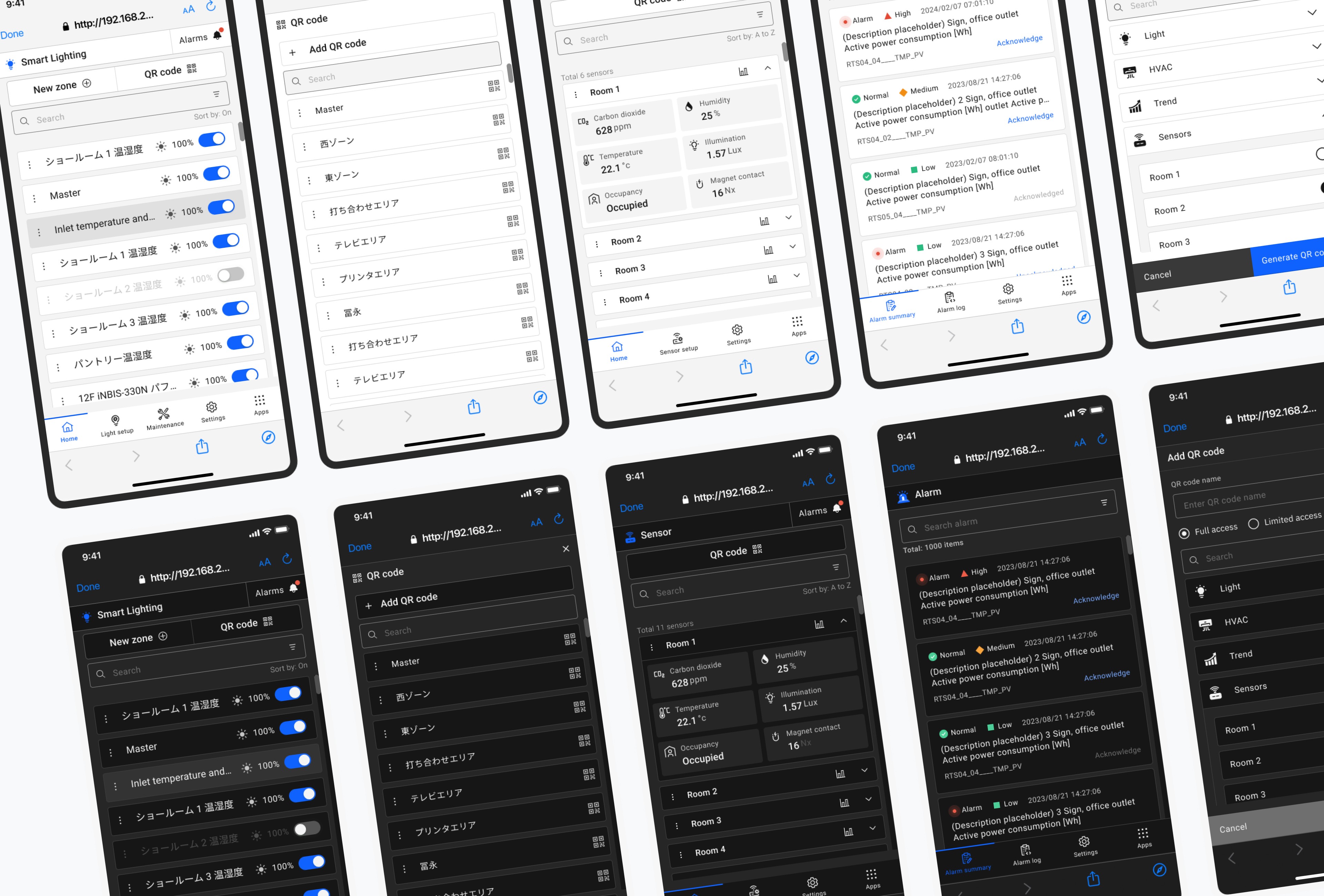
Sensor Application: Monitors temperature, carbon emissions/air quality, relay runtime hours, cycle counts, and other vital parameters to support predictive maintenance, energy optimization, and healthy indoor environments.
Design Process
The project followed a rigorous, user-centered design methodology with strong emphasis on heuristic evaluation and iterative refinement:
Research Phase
Comprehensive stakeholder interviews, contextual observations, and workflow audits were conducted with facility managers, field engineers, and end occupants across commercial and industrial sites. Pain points in legacy BMS systems were mapped, including fragmented interfaces, excessive manual configuration, and lack of spatial context. Competitive analysis and industry benchmarking informed opportunities for differentiation.
Personas & Journey Mapping
Detailed personas were developed representing key user segments: technical administrators, field maintenance engineers, and temporary space occupants. Experience maps highlighted friction points in daily operations, provisioning workflows, and decision-making under time pressure.
Information Architecture & User Flows
Optimised flows were designed around a software-defined spatial engine. Core concepts such as Virtual Zones were introduced to replace rigid physical circuits. Task flows for zone creation, hardware discovery, and QR-based access provisioning were refined for maximum efficiency.
Wireframing & Interaction Design
Low-fidelity wireframes evolved into detailed high-fidelity designs. Particular attention was given to granular controls, including stepless dimming sliders, climate scrubbers, and dashboard visualizations.
Prototyping & Heuristic Evolution
Interactive prototypes were built and subjected to multiple rounds of heuristic evaluation based on Nielsen’s usability heuristics and domain-specific OT principles. Identified issues — such as cognitive load in configuration screens, visibility of system status, and error prevention — drove targeted refinements. Iterative heuristic reviews ensured progressive enhancement of consistency, flexibility, and error tolerance across modules. This heuristic-driven evolution was instrumental in transforming complex industrial interactions into intuitive, error-resistant experiences.
Usability Testing & Validation
Iterative testing sessions with representative users validated the design. Feedback loops informed final adjustments to micro-interactions, information hierarchy, and mobile responsiveness.
Collaboration
The project benefited from close cross-functional collaboration between UX designers, software engineers, hardware specialists, and client stakeholders. Regular design critiques, joint heuristic reviews, and agile sprints ensured alignment between technical constraints and user needs throughout the development lifecycle.
The Challenge
Traditional Building Management Systems (BMS) suffer from significant operational inefficiencies driven by fragmented tools and manual processes. Facilities teams must manage disparate physical controllers, standalone software, and hardware-specific interfaces, resulting in high cognitive load and excessive man-hours.
Key challenges include:
Fragmented spatial control and mental models that make it difficult to map physical circuits to actual building layouts.
Lack of actionable, glanceable insights into energy consumption and system performance.
High friction in provisioning temporary or localized access for occupants, often requiring IT intervention or security trade-offs.
Reactive maintenance practices due to buried diagnostic data.
Substantial manual effort in daily operations, which is particularly costly in markets facing severe manpower shortages, such as Japan.
These issues lead to increased operational costs, higher energy consumption, carbon emissions, and reduced equipment reliability.
Opaque Operational Intelligence: Energy consumption and system performance data remain isolated and non-intuitive, making it difficult to correlate spatial decisions with actual power utilization or systemic behaviors.
Solution
The Smart Application replaces rigid physical infrastructure with a flexible, software-defined spatial management framework. It abstracts hardware complexity into intuitive digital controls centered on Virtual Zones that reflect real-world spaces (e.g., meeting rooms or office suites).
Core Architecture: Industrial Hardware Layer → Software-Defined Spatial Engine (Automated Discovery + Virtual Zoning) → Unified Micro-Frontend Interface
Key Design Features:
A. Intelligent Configuration & Zoning
Automated hardware discovery enables rapid onboarding and synchronization across projects. Administrators can easily create and manage virtual zones through drag-and-drop reordering and contextual power-load calibration. This eliminates manual circuit mapping and physical rewiring.
B. Granular Control Interfaces
Lighting Controls: Simple On/Off toggles, smooth 0–100% dimming sliders, and dynamic zone grouping for precise, localized management.
PAC Climate Controls: Consolidated dashboard with mode selectors, fan speed steps, airflow direction swings, and high-precision temperature scrubbers.
Trend Analytics: Energy multiplier logic powers clean line charts and real-time totalizers, making consumption patterns visible and actionable.
Sensor & Maintenance Dashboard: Continuous monitoring of temperature, carbon emissions/air quality, runtime hours, and cycle counts to drive energy efficiency, lower carbon footprints, and ensure compliant, healthy indoor environments.
C. Zero-Friction End-User Access
A powerful QR Code Provisioning Engine allows administrators to generate secure, zone-specific access codes with defined permission levels. Occupants simply scan the QR with any mobile browser to receive instant, context-aware access to relevant controls (Lighting or PAC) — no app downloads required.
Result
The Smart Application has delivered substantial, quantifiable improvements through its refined, heuristic-driven user experience:
Increased overall task efficiency by 22% and reduced site and device configuration time by 28%.
Real-time Improved field engineer efficiency by 32%.
Visible Reduced man-hours by 23%, directly addressing manpower shortages while lowering operational costs.
Elevated user satisfaction by 34% across all IoT applications.
Beyond metrics, the platform has transformed operations from reactive to proactive. Real-time visibility into energy, CO₂, and sensor data enables meaningful sustainability gains, while predictive maintenance insights extend asset life and minimize downtime. Occupants enjoy seamless, localized environmental control, and administrators benefit from secure, centralized governance.
Through meticulous heuristic evolution and iterative refinement, the Smart Application exemplifies best-in-class enterprise IoT design — converting complex industrial systems into simple, powerful, and deeply human-centered experiences that drive measurable operational excellence, sustainability, and business value.